Sunday, June 9, 2013

Everything Happens for a Reason


We missed our train to Cape Town. 

Fortunately, we still had a free place to stay with Craig, a tech journalist. We also ended up getting invited to go with him to a movie screening at a nearby Jo'berg flat. It was a festive gathering we would have missed if we would have made it to the train station just a minute and a half earlier. 

We were lucky too to get some really cheap plane tickets through Steve, another new South African friend who directs That's Hectic!, the South African version of Sesame Street. With the plane tickets, we wound up getting to Cape Town even earlier than we would have via our original 26-hour train ride, the only difference being we got to go to a fun little party instead of sitting on a train.

As for the movie screening itself, there was an intriguing mix of people present -- an eclectic gathering of salsa dancers and intellectuals. Indeed, the hostess was one part Oxford-educated English professor, two parts salsa-dancing machine.

Out on the balcony we talked with architects, scientists, journalists, South African think tank members, and various salsa dancers. After drinks and appetizers, we watched the 1930s film, "Trouble in Paradise," a movie I likely never would have picked out myself. The movie was surprisingly charming and entertaining -- and pretty risqué for the 1930s I might say. We had home-made bread, home-made sushi, and some nice champagne.

In the end, I was glad we missed the train.

They say everything happens for a reason and I couldn't agree more. However, the phrase as it is commonly used may be one of my least favorite cliches. It seems to suggest that there is some pre-ordained divine plan, that bad events happen not because of explicable causes, but simply because "it was meant to be."

I prefer a more straightforward interpretation: most events do happen for a reason, but that reason is usually a complex set of causes, some of which may be beyond our current comprehension. As for missing the train, we just didn't give ourselves enough time.  

I think one of the hardest questions for philosophers and religions to answer is, why do bad things happen? While it's hard to give any satisfying, broad answer to the question, I think it's dangerous, irresponsible, and an insult to human free will to suggest that bad events happen because they were meant to happen as part of some larger plan we don't understand. It stifles attempts to uncover true causes, and worst of all, stifles action to prevent bad things from happening in the future.

When a young girl gets cancer, I don't like to think that it was meant to be, or that it is all part of God's plan. I like to concentrate instead on understanding the DNA mutations that may have led to it happening, on understanding how environmental toxins may or may not have played a role, on how we may not have done enough research yet to enable a cure for her, on how we could invest more money in biomedical research if we valued it, and on the fact that perhaps better healthcare may have helped her earlier on.

By thinking about causes, we are in a better position to take actions to change the course of future events with our own free will. The more we understand how negatives arise, the more we are able to agitate for positive change in the world.

Most importantly though, I think carefully analyzing causes is still fully compatible with empathy and finding meaning and purpose in life's hardest blows. The cancer patient's diagnosis may inspire her brother to become a great scientist to help girls like his sister in the future. The diagnosis might lead her mom to value every second she has not only with her sick daughter, but with her other kids and with her husband as well, helping her come to the realization that we should love as much as we can while we still can. The diagnosis may bring the whole family closer together than they ever would have otherwise been. These silver linings are what we must seek constantly in life. 

I just think it's crazy, however, to mistake the silver linings that come out of bad events for being the very reason that bad things happened in the first place. While I suppose these days most people say "everything happens for a reason" somewhat sardonically, it seems like there's still a lot of people that really believe it.

As for me, I think life wouldn't be quite as exciting if the tracks had already been laid, humans all just passengers on a train pre-made.


Tuesday, June 4, 2013

Gettin' Wild


The morning after flying in to Johannesburg, South Africa, I embarked upon a four day Kruger National Park safari. The drive out of Johannesburg is nothing exciting as Johannesburg is somewhat in the middle of nowhere (Jo'berg is the largest city in the world that is not next to a river, lake or coastline; it exists mainly because of a massive gold rush in the 1880s), but things got more and more beautiful as we neared Kruger.

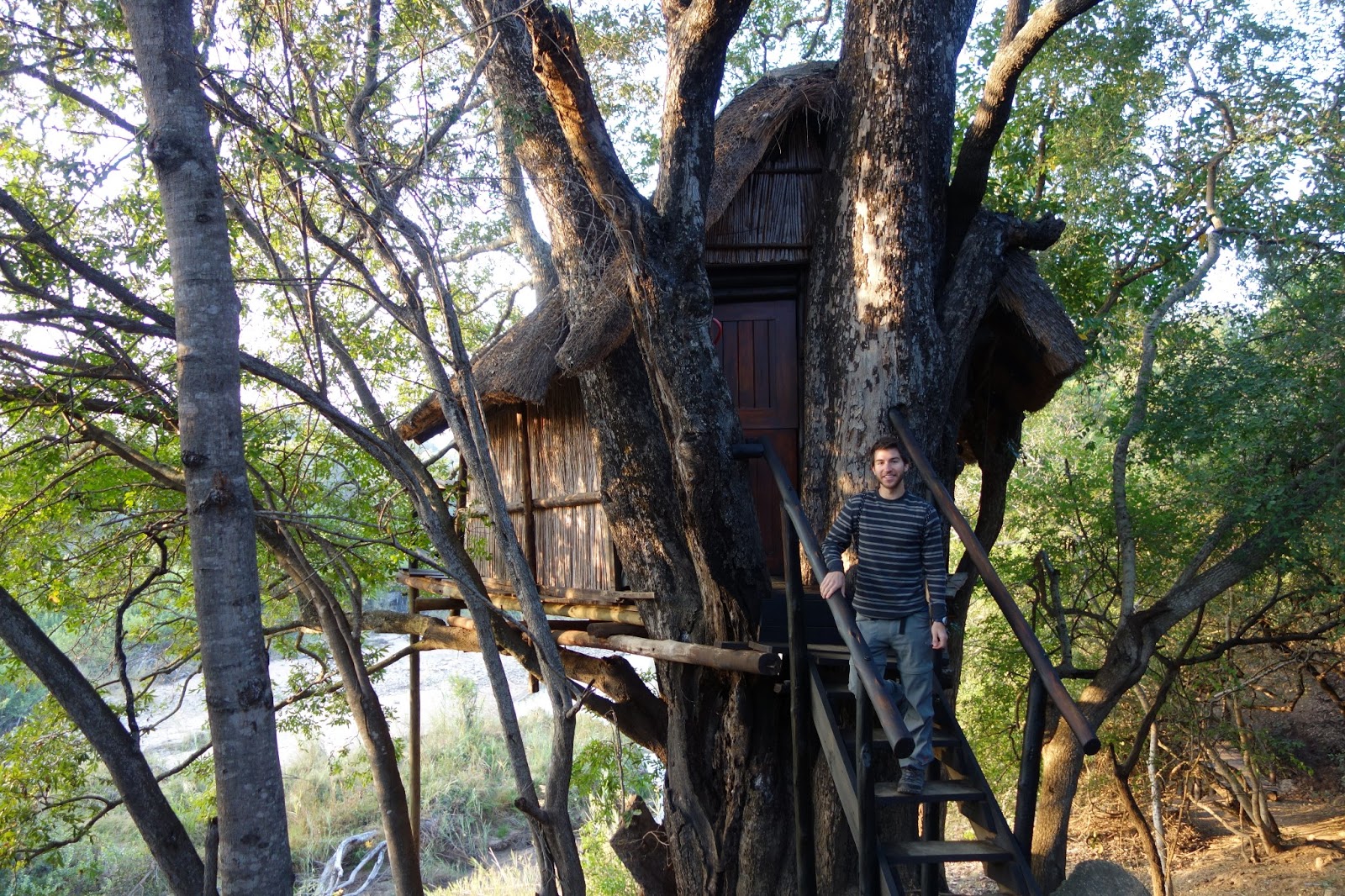
Kruger National Park is one of the top places in the world to do a safari as it has some of the densest concentrations of large predators in Africa. It is also the site of the famous lion, crocodile, and water buffalo epic that went viral on YouTube. Enhancing the experience, I got to stay in the African bush in a treehouse overlooking the Klaserie River. Monkeys hopped around on the treehouse roof, antelope wandered the grounds, and giraffes even made a celebrity appearance at one point. 

The safari cruises and bush-walks themselves were awesome. My favorite was a night drive during which we followed a lion through the bush. Second favorite was a walking safari outing where -- this time on foot -- we again tried tracking a lion (unsuccessful), leopard (unsuccessful) but also some elephants (great success). I enjoyed analyzing the elephant tracks to see which way they going, how recently they were there, their sex, and roughly how old they were. 

To be sure, being on foot is far more exciting than viewing animals from a LandCruiser, especially when you're walking paths you saw lions padding along the night before. At one point too we had to walk briskly away from a couple of huge African elephants coming our way.

Throughout the four days I got to see a good variety of animals: lion, rhino, elephant, water buffalo, jackal, wildebeest, monkey, baboon, giraffe, impala, hippopotamus, crocodile, warthog, eagle, kudu, and water buck. Out of the big five, we only missed the elusive leopard.

One night on my way to dinner, I heard loud crackings and movement in the dark bush next to me. Unfortunately, I only had a wimpy flashlight and couldn't make out what it was as it got closer and closer. As a result, I was only a couple feet away when a massive African water buffalo bull stepped into the path. They are generally considered the most dangerous animals in Africa, killing more people than lions or any other big game besides the hippo. African water buffalo are also infamous for being very unpredictable. We looked at each other for a moment before I quietly high-tailed it out of there, having been warned that there were some in the area that have charged people before. 

Later too when a man from Holland and I were trying to get to our treehouses at night we had to turn back as there were two large bulls in our way. We ended up sipping beers for an hour and a half waiting for the buffalos to wander toward the river, as they usually do later at night.

I wondered before if a safari would be significantly different enough from a zoo to make it worth doing. In addition to the beauty of the land and the imagination it kindles, I would certainly say it was worth it in terms of pure animal viewing too. 

The biggest difference might be the social elements: seeing animals in large herds, interacting amongst themselves while eyeing the many other species at the watering holes, was fascinating. In a zoo you never get to see a bunch of hippos scattering away as a large elephant walks up to the water; you never come to the poignant realization that an older water buffalo has been kicked out of the pack by jealous younger males, and you never see just how zealously every species guards their young when there are no walls separating them from danger.

I definitely wouldn't last too long on my own in Kruger. I suppose I can only say I'm proud I'm descended from people who could, and that deep down I have at least a little Wild in my blood.


Tracking a lioness at night.

Elephants on the plains.

African long-neck horse.

Zebras. 

Though many attempts have been made to domesticate the zebra, including well-organized modern efforts, none have been successful. Turns out they get super mean when they're older. 

In Guns, Germs and Steel, Jared Diamond talks about the factors that have disqualified seemingly good large mammals from domestication. Good domesticates: can't be predators (takes too much biomass to raise them efficiently); must grow quickly; must be able to breed in captivity; can't be too mean; can't have a tendency to panic; and must have inbuilt social hierarchies.  

For example, although the Egyptians found tamed cheetahs to be masterful hunters far superior to dogs, they have never been domesticated. The problem: they can't breed in captivity. In order for the female to be aroused enough to ovulate and do it, she has to be chased for four days by a group of male cheetahs. Apparently, this hasn't worked out well in zoos.

As for zebras, they "have the unpleasant habit of biting a person and not letting go." They're finicky. Professional cowboys can't even lasso them thanks to the zebra's uncanny habit of eyeing the rope noose flying toward them and then ducking their heads at the last second.

In general, despite its abundance of large mammals, Africa got the short stick when it came to animals good for domestication. Indeed, examining mammals over 100lbs by continent:
  • Eurasia: 72 candidates, 13 domesticated (18%)
  • Sub-Saharan Africa: 51 candidates, 0 domesticated (0%)
  • The Americas: 24 candidates, 1 domesticated (4%)
  • Australia: 1 candidate, 0 domesticated (0%)

 Even with all our current scientific knowledge, we have been unable to crack the African mammals.


Rhino's (now endangered because of poachers) have four tons of meat on them. In terms of domestication, they have too fierce a disposition, and grow too slowly.


 Elephants take 15 years to grow up, making them totally not worth the effort for domestication.


However, their babies are pretty cute, and could compensate for the time lost.


Antelopes are everywhere in Kruger and seemingly good candidates. Their major flaws include a tendency to panic (not good for herding given their extraordinary speed and jumping ability)... and seasonally territorial males. 

The sun setting on Kruger.

This tree is over a thousand years old. Apparently the bushmen used to carve out rooms inside them. They were certainly big enough for doing so.

 And to think I thought the parties in Rio were wild.


With the guides. 

Tracking elephants.

Can you see one in the bush?

Checking in on the hippos. 


Two too many late-night water buffalo encounters.


Ever contemplative, the monkey.


Former giraffe.

Treehouse in the bush.

Sunrise near our camp.

At the Blyde River Canyon.


Monday, May 27, 2013

Keepin' it Rio: The Marvelous City


To cut to the chase: Rio de Janeiro, Brazil, is up there for my favorite places in the world. Our week in the Marvelous City was indeed marvelous, although I unfortunately didn't take my camera out often (I didn't want to lose it to a pickpocket). As for why I loved Rio, here's a few reasons that come to mind:

1. Beautiful beaches. You just can't beat long, wide, white beaches carved out of luscious green mountains.
2. Beautiful people. Everything you have heard about Brazil having a lot of beautiful people is true. The people here are tan, fit, and the products of a great melting pot of ethnicities. There's actually a good amount of psychological research that indicates people find computer "averaged" faces more beautiful -- I wouldn't be surprised if mixing lots of races achieves this effect too.
3. A happy, care-free attitude. Especially compared to the giant metropolis of Sao Paulo, any Brazilian will tell you that the people here are easy-going. Just walking around the streets, I have seldom seen so many happy and friendly people.
4. An emphasis on fitness and sport. Every beach is lined with sand soccer fields and volleyball courts. There are also always thousands of people running, biking, and skating along the boardwalks.
5. Easy access to trails, gardens and nature. There are lots of parks, gardens and trails here. Like most humans, I love being surrounded by greenery.
6. Good, fresh food. Rio is right next to the sea + in a tropical region + in a country with lots of livestock. The result is tasty seafood, amazing fruit, and superb steak.
7. Enjoyable music. This may apply to Brazil more as a whole, but there's pretty good music here. The Jorge Ben Jor concert we went to was exactly what I was looking for -- an awesome fusion of samba, rock, funk and bossa nova. He's pretty old, but the young Brazilians love him as much as their parents do.
8. Hoppin' nightlife. We had a lot of nights when the sun was out before we got back home. A central area called Lapa is crawling with Brazilians looking for a good time at one of the city's countless bars and clubs. We also explored a few other venues, like going to a giant "Favela Funk Party" inside one of the slums.

As for things that affect quality of life and daily living, it's hard to top Rio's offerings. There's a lot of people that move here after visiting, and I wouldn't rule out coming back someday.

What's missing? Compared to some of my other favorite cities in the world, it's missing the deep, rich history that Istanbul has and it's missing the sleekness and modernity that Hong Kong has. It also doesn't have quite as many museums and cultural offerings compared to other bigger cities (although we did love our visit to the city's Modern Art Museum).

Lastly, and most detrimentally, there is undeniable inequality here. The main Zona Sur is wonderful and mostly clean, but the city is surrounded by favelas (slums) that have been mostly left out of Brazil's economic progress. While the country has the strongest affirmative action policies in the world and other efforts to combat inequality, many Brazilians are cynical their effectiveness so far. Nonetheless, most people seem to think things are very slowly getting better for the poor.

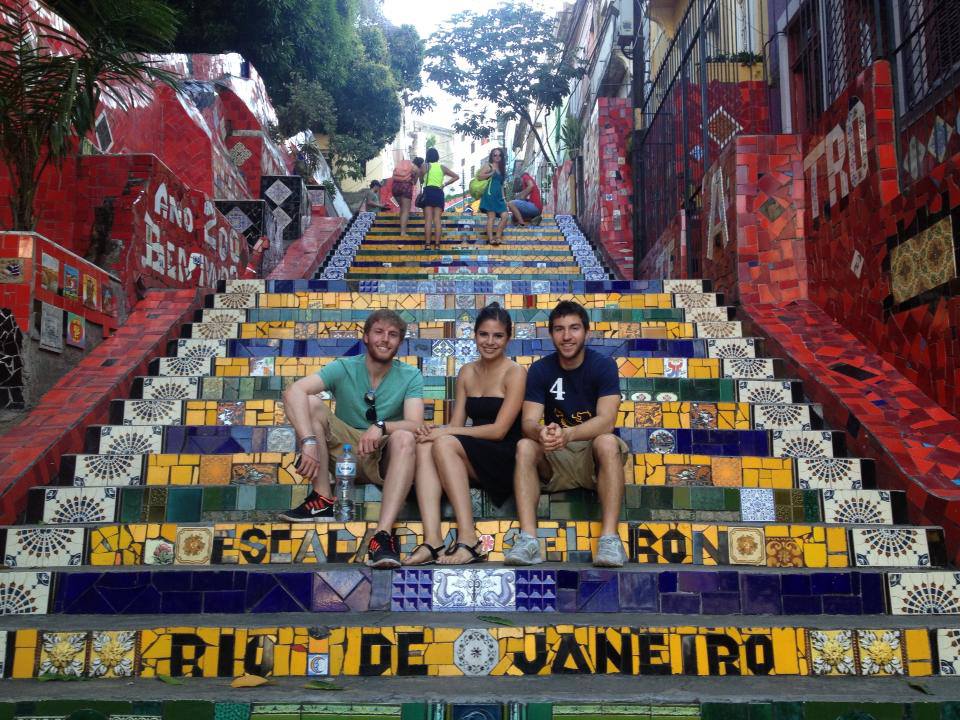
The famous Lapa steps were made by Chilean Jorge Selaron as a tribute to the Brazilian people. The steps are made from thousands of tiles from all over the world, including even Minnesota.Copacabana Beach, down the street from our hostel.

Christ the Redeemer.


We had an awesome crew at our hostel. Here a few of us eating at Porcao, a Brazilian steakhouse.


I'm not sure who saw and who did.

Sculptures in Santa Teresa, the Bohemian area of town


Sunset from Sugarloaf mountain.

Christ overlooking the city.


The beach is chock-full of soccer fields. Talk about paradise.

Lots of green space.


All the inlets and curving shorelines make for an inordinate amount of beach.


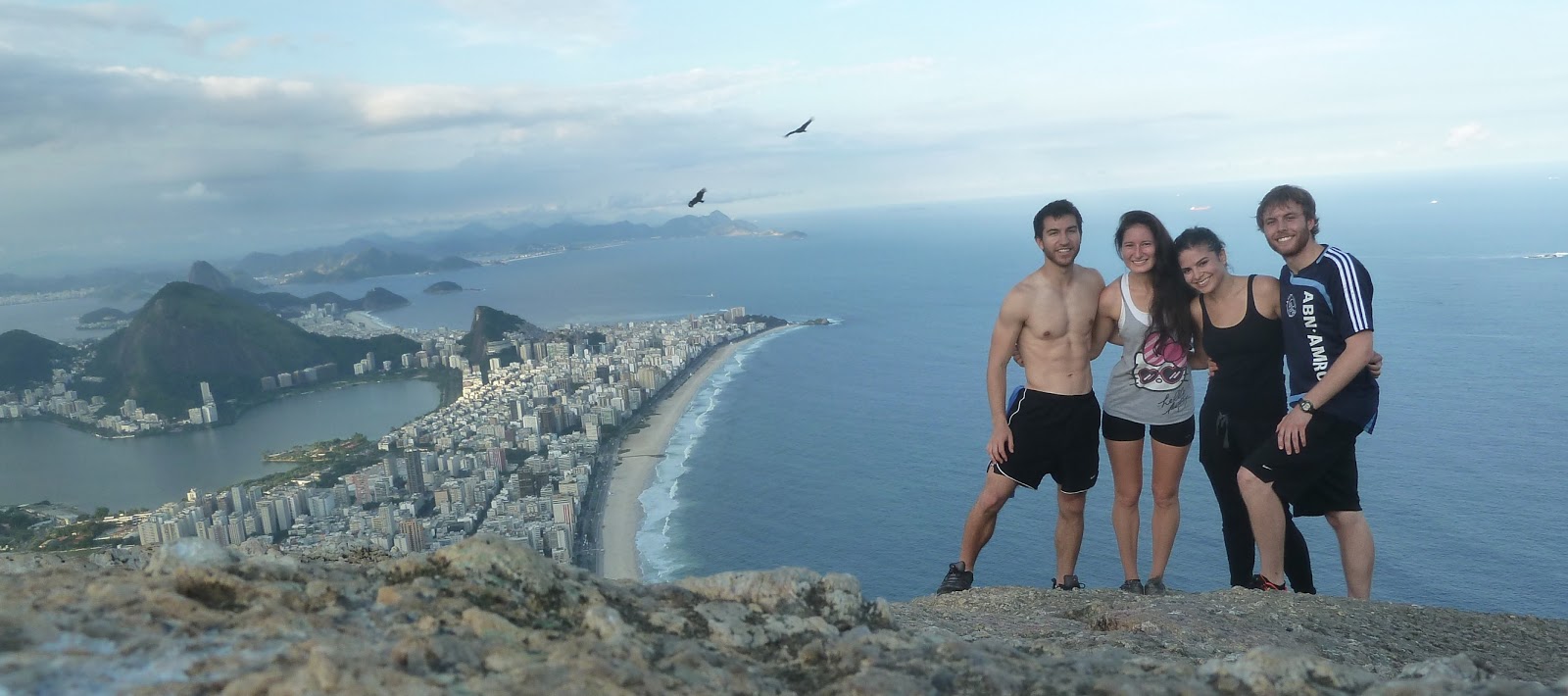
We hiked Dois Irmaos, the mountain overlooking Ipanema. To get to the bottom of it, we took motorbike taxis through one of the slums on the outside of the city -- an exciting ride and a cool climb.


Ipanema from the mountain.


Snoop Dogg and Pharell appropriately filmed their hit song, "Beautiful," in Rio. 

After a traditional homemade Brazilian dinner at our friend Laura's apartment, we spent the night listening to her roommates play Niel Young and Johnny Cash. Too bad we have to leave Brazil, but South Africa awaits!